While we passed the 1,5° Degrees on average – IPCC predicted this overshoot – and it takes time for reductions to bring temperatures down later, countries should also have temperature reduction commitments in addition to emission reduction targets. They should start cooling their countries and cities. The European Human Rights Court -in the KlimaSeniorinnen case- even requires governments to do that.
Greening EU’s urban areas would reduce urban summer temperatures by 2.5–6°C; the pledged 30% reduction of methane limits global temperature already with 0.2°-0.5°C
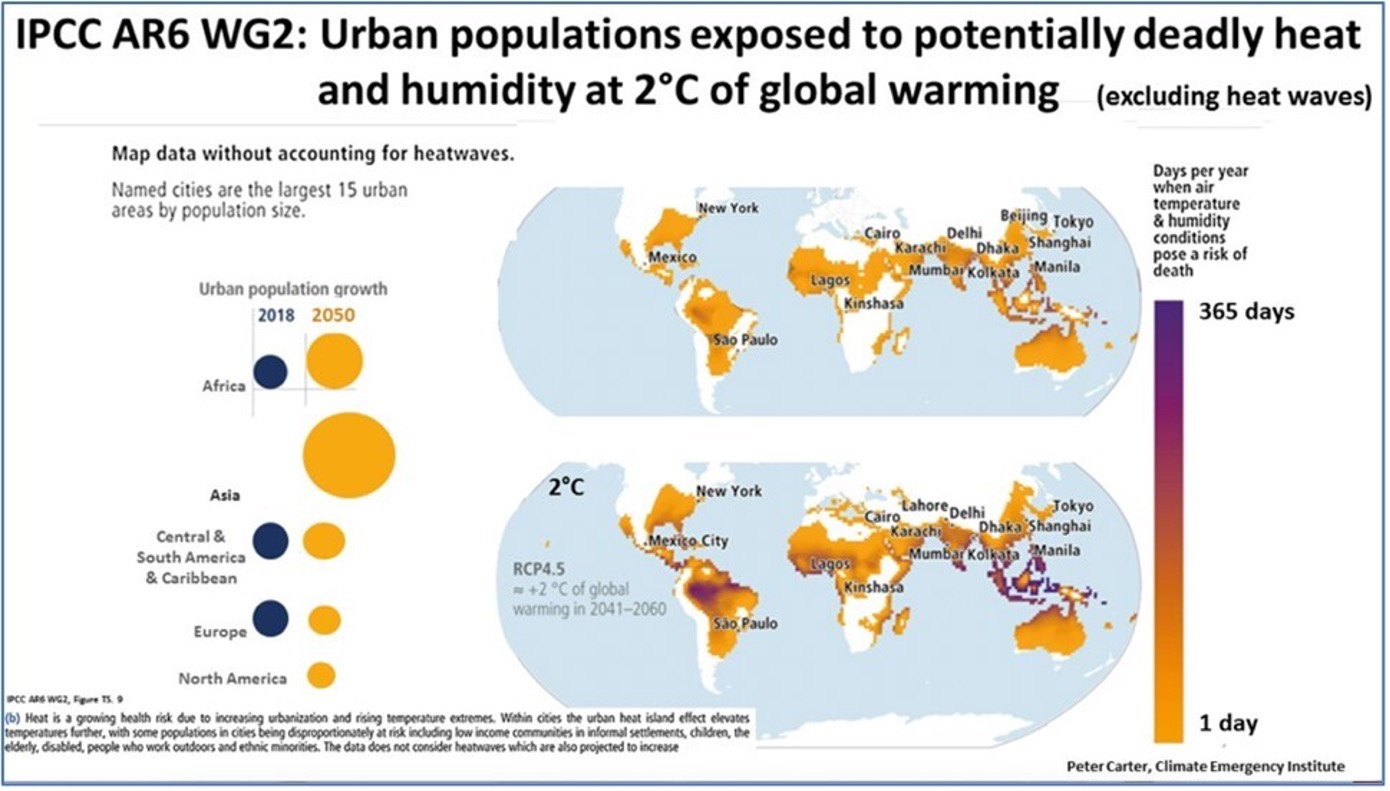
The IPCC warned of deadly heat from the enhanced greenhouse effect in cities at 2 degrees of warming. Previously, scientists wrote that the Earth will become a ‘Hothouse Earth’ faster and earlier. The climate impact of extreme heat is now becoming tangible. In Asia we currently see temperatures above 50 degrees, in Africa the worst drought in 40 years is at home, in Australia and the US the worst forest fires ever raged earlier, while in Spain is led to flooding, and in the Netherlands the soil dries out earlier in the year and the water level of lakes is lowered.
In the case by the ‘KlimaSeniorinnen’ against Switzerland, the European Court of Human Rights ordered the State to take practical measures to protect seniors against climate heat stress in urban area’s:“take adequate measures to protect them from the harmful effects of climate change on their lives and health”.
Especially now that the world is slowly overshooting 1.5 degrees Celsius, temperature reduction measures taken by countries have an immediate effect
It ís already possible to take practical measures to immediately reduce the average temperatures in towns and country. And because the heat itself has now become so urgent, I argue that in addition to emission reduction targets, which only take effect after years, countries should also commit to temperature reductions and start cooling their countries and cities. This directly prevents warming to some extent. And the larger the surface area that is addressed in a country, the greater the proportion that gets a lower temperature, resulting also in a lower average temperature.
Every Gton of CO₂ removed from the atmosphere immediately lowers atmospheric CO₂ concentration and contributes to a measurable reduction in radiative forcing. Scientist Johan Rockström said that, to counter residual emissions and Earth-system feedbacks in order to stabilise global temperature after an unavoidable overshoot, 10bn tonnes carbon removal every year can limit global heating to 1.7°C.
What kind of measures cool down?
What is the temperature effect of certain measures? A few examples
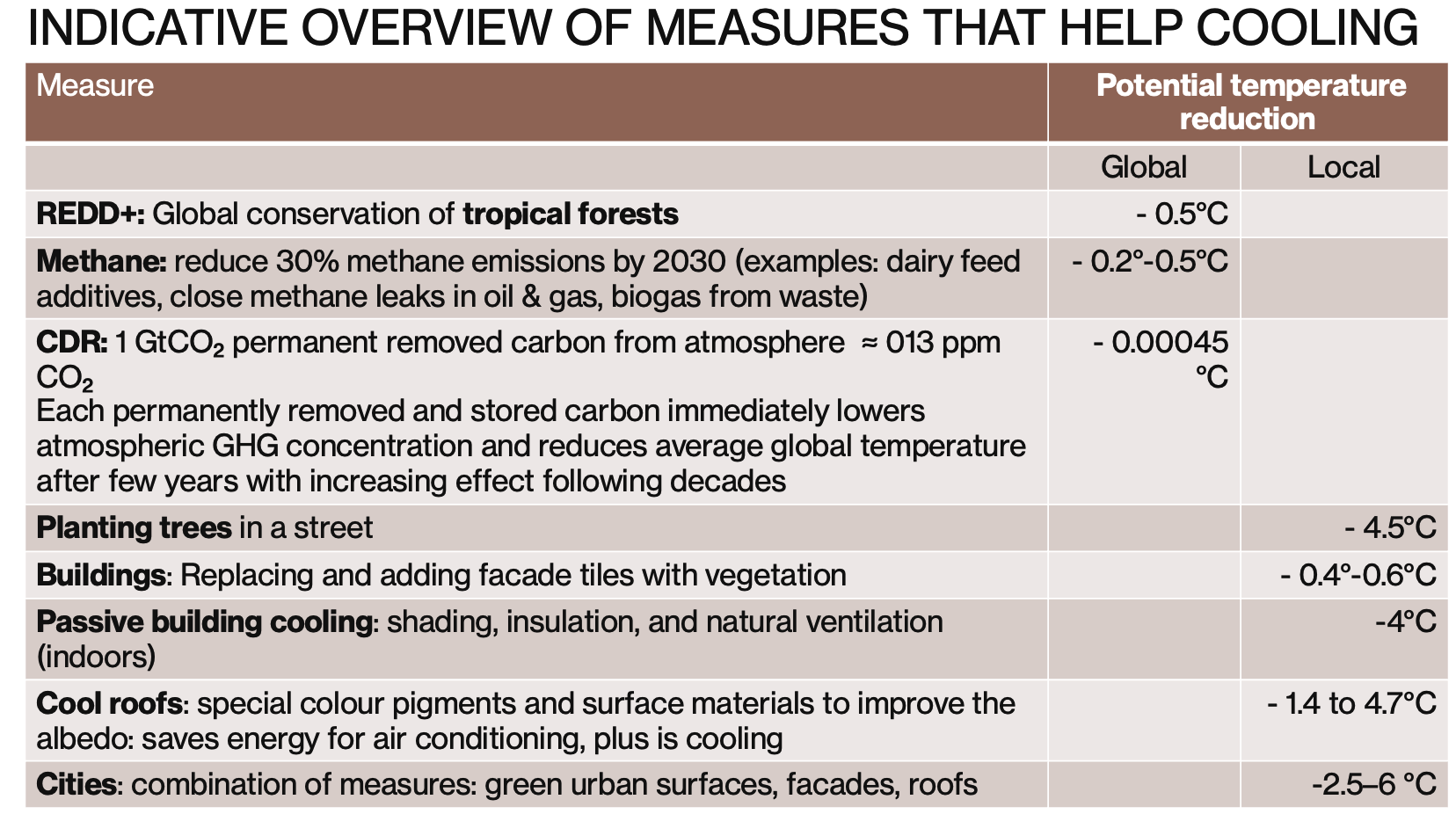
Global temperature reduction:
- Global conservation of tropical forests will already keep the earth 0.5°C cooler;
- Increase the ‘Albedo’ effect (reflecting the heat back), by whitening surfaces, so that the heat reflects and is not absorbed. This can be done with white roofs or with afforestation, grassland management and high-albedo crops. Cost to do this on a few hectares is low, but global temperature impact is near zero (nanokelvin scale), but locally -3°C (see below).
- Methane reduction. 25 countries pledged to reduce methane emissions by 30% by 2030. Environmental Defense Fund calculated that this could slow the warming rate by 30%. This could further limit warming by 0.2°-0.5° C in 2050. And this concerns methane from the oil and gas sector and the waste sector as well as livestock farming. Dairy companies can using feed supplements to reduce enteric methane from dairy cattle leading to 15-30% less methane.
- Carbon Dioxide Removal leads to cooling. 1 GtCO₂ permanent removed carbon from atmosphere lowers ≈ 0.13 ppm CO₂ and temperature reduction of 0.00045°C. Removing 220 Gt would equate to roughly a 0.1°C reduction globally
Hence, each permanently removed and stored carbon immediately lowers atmospheric GHG concentration and reduces average global temperature after few years with increasing effect following decades. Johan Rockström said that 10bn tonnes carbon removal/yr is necessary to limit global heating to 1.7°C. - Safe large-scale international ‘geo-engineering’ projects are also being considered, in which, for example, sulfur particles are dispersed in the air or ocean or clouds are made whiter to cool the earth. The UN Climate Overshoot Commission, consisting of 15 former leaders and ministers gave answers on sensitive questions on the role of CO2 removal and geoengineering in climate action. In the Report of September 2023, they preferred the use of carbon removals; it was more cautious on ‘geoenineering’ (reduce solar radiation impact) and demanded more small scale research, especially in the South. The Human Rights Council Advisory Committee was in their recent report, July 2023, was even more cautious; but they are also cautious on the use of removals and carbon markets in general.
Local temperature reduction:
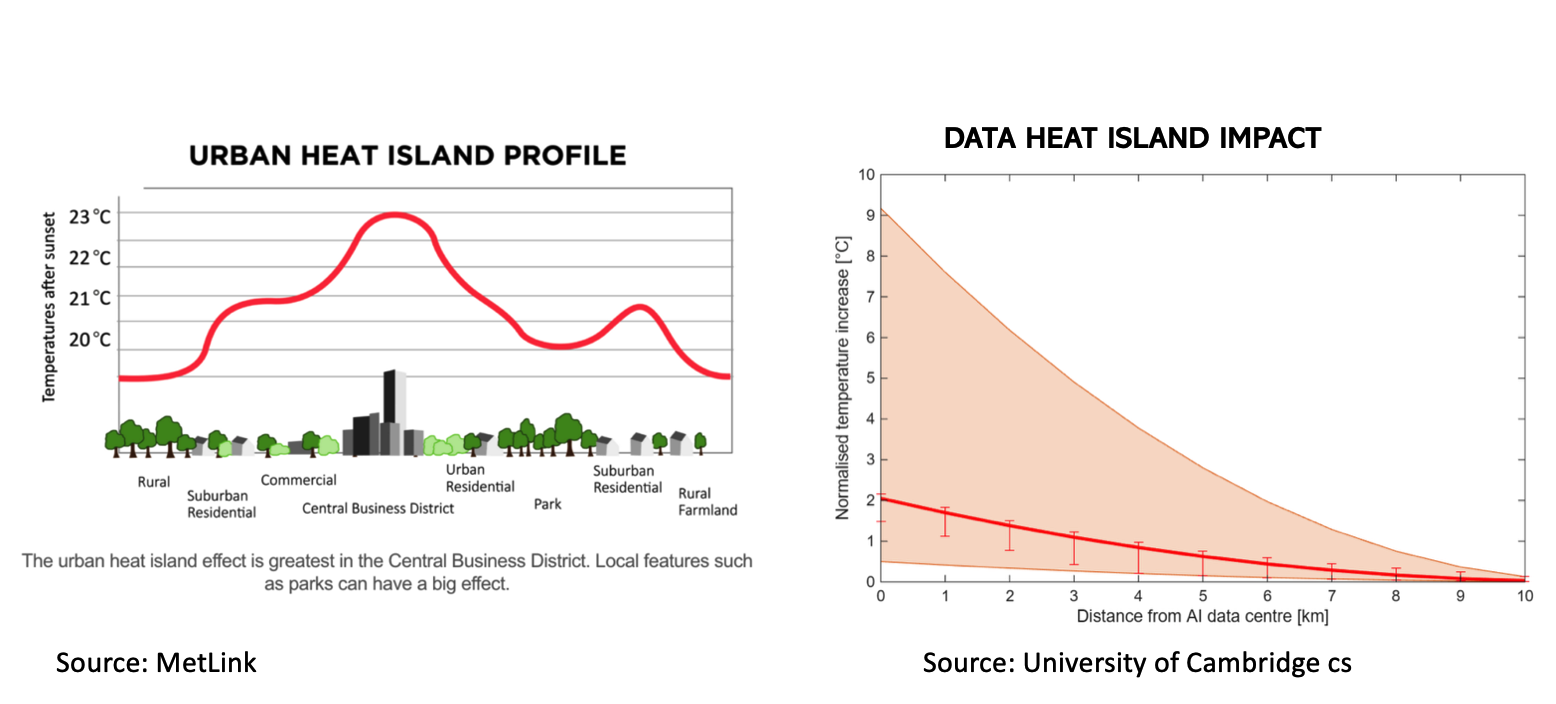
- At the urban level, the albedo effect is stimulated by urban planners with Green-Blue-Infrastructure (GBI) and they use models to calculate the temperature reduction. In many countries there are urban GBI initiatives for the benefit of biodiversity and a healthy living environment. Inner cities were already 4°C warmer than other parts of the country (Urban Heat Island). Exposure to data centers can increase that with up to 9°C (Data Center Heat Impact). Due to warming, it can easily be 10°C warmer in large cities than in the countryside and 6°C warmer in smaller places. So, it is also necessary to reduce the local heat and prevent heat stress
- Replacing and adding building facade tiles with vegetation can reduce the local temperature by 0.4°-0.6°C.9
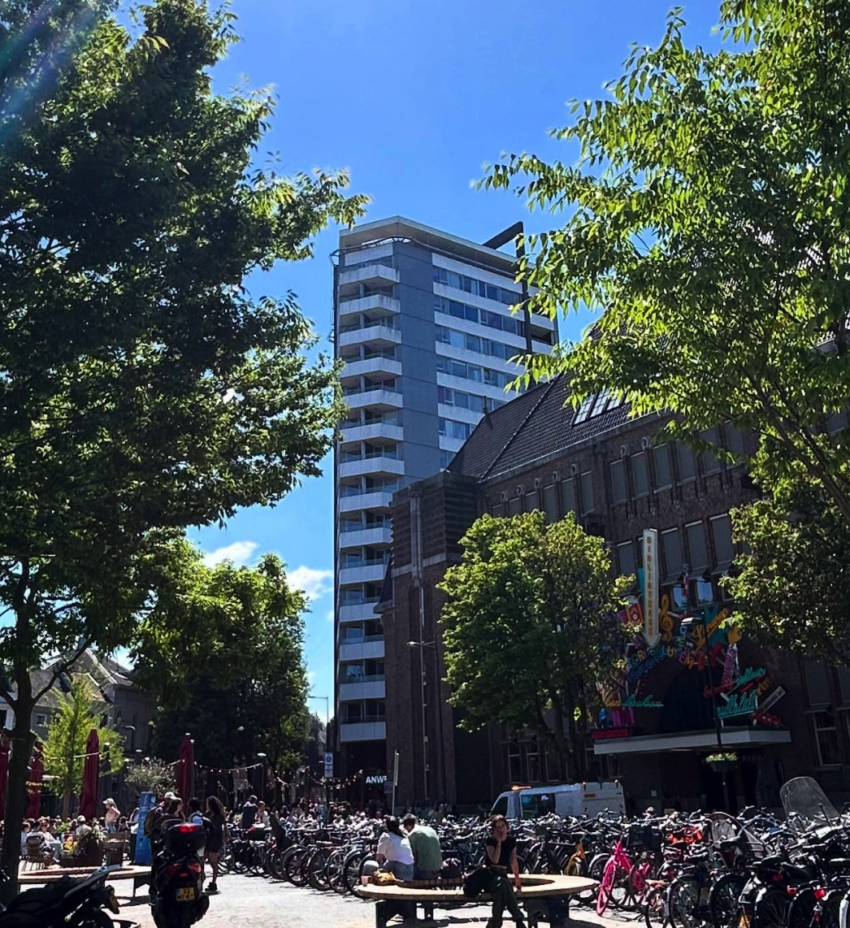
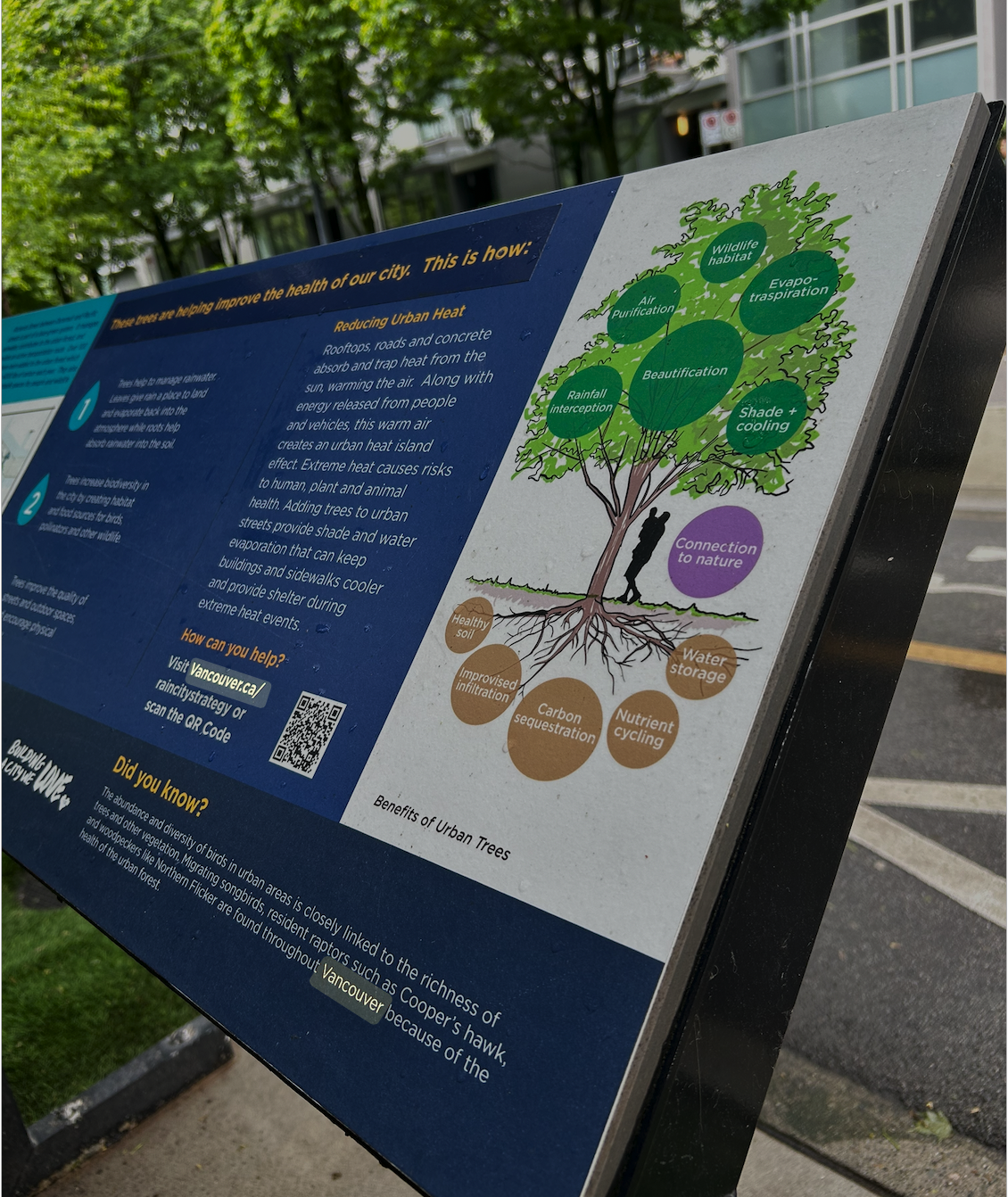
- Trees in a street can reduce the temperature by 4.5°C. By shading: trees block direct solar radiation from hitting dark asphalt and concrete. And by vapotranspiration: plants release water vapor, which absorbs ambient heat as it evaporates into the air.
- Buildings with ‘Cool roofs’, special colour pigments, mosscrete, and surface materials to improve the albedo, save energy for air conditioning plus could reduce the ambient temperature by 1,4-4,7°C; study by Leuven University show a combination of measures in building can help urban adaptation via reducing temperatures by more than 2 degrees and reduce heat-related deaths with 25% in Belgium
- Greening of EU’s urban areas would reduce urban summer temperatures by 2.5–6°C, reducing the urban heat island effect. Applying to 2/3 or EU Cities could on top have an estimated NPV of €221 billion over a period of 40 years. The monetary benefits would cover less than half of the estimated costs of greening: biodiversity, water quality, health and well-being and amount to around €60/year per European city dweller.
- Cooling of Arctic Ice itself, like the Dutch Arctic Reflections wants to do, is directly comparable with preventing CO2 impact and keeping carbon out of the atmosphere. 1 ton of CO2 breaks down 650 ton glacial ice. 100.000 ton of Ice increase is like removing 154 ton CO2 out of the atmosphere.
So why not make cooling part of national agreements?
Countries could make an agreement in their Climate Plan to effectively reduce the average temperature in their country by x° Celsius. I am curious to see what scale can be achieved, but the above examples are promising. The elaboration must of course take account of differences between countries, climate zones and weather types and the extent to which they can achieve lower temperatures locally or regionally. And it will not be possible to agree on a mandatory final temperature reduction. However, concrete cooling can already be achieved. Especially now that the world is slowly overshooting 1.5 degrees Celsius, temperature reduction measures taken by countries have an immediate effect.