Mijn artikel in het Nederlands Tijdschrift voor Energierecht (NTE) van 2 december 2025 staat online. Door de uitbreiding van de reikwijdte van het ETS en de toenemende ambitie rijst de vraag of het ETS de verplicht deelnemende bedrijven vrijwaart van additionele, individuele CO2-reductieverplichtingen, opgelegd via art. 6:162 BW (onrechtmatige daad) en de maatschappelijke zorgvuldigheidsplicht (English below).
Het Gerechtshof van Den Haag maakt in de klimaatzaak van Milieudefensie tegen Shell, zoals ik in het artikel aangeef, duidelijk dat die vrijwarende werking er inderdaad is. In dit artikel bespreek ik in hoeverre het ETS de deelnemende bedrijven vrijwaart van claims voor verdergaande CO2-reductieverplichtingen, op basis van het principe ‘ex lege libertas’: dat is dat de wet beschermende werking heeft voor degenen die daar onder vallen. En ik plaats dit in de context van Nederlandse, Duitse en internationale rechtspraak.
Bedrijven zijn niet gevrijwaard van schadeclaims bijvoorbeeld. Maar het principe betekent naar mijn mening wel dat bedrijven die onder het ETS vallen ook een bank als financier mogen hebben (denk aan de actie tegen ING), reclame mogen maken in openbare ruimtes, fossiele subsidies mogen hebben en geen verbod op het boren naar olie of gas opgelegd kunnen krijgen, Die vrijwarend werking gaat dus best ver, maar het ETS met het CO2-plafond, is dan ook een vergaand CO2-reductiesysteem.
Lees het artikel hier. Gepubliceerd in het Nederlands Tijdschrift voor Energie en Recht, 2 december 2025.
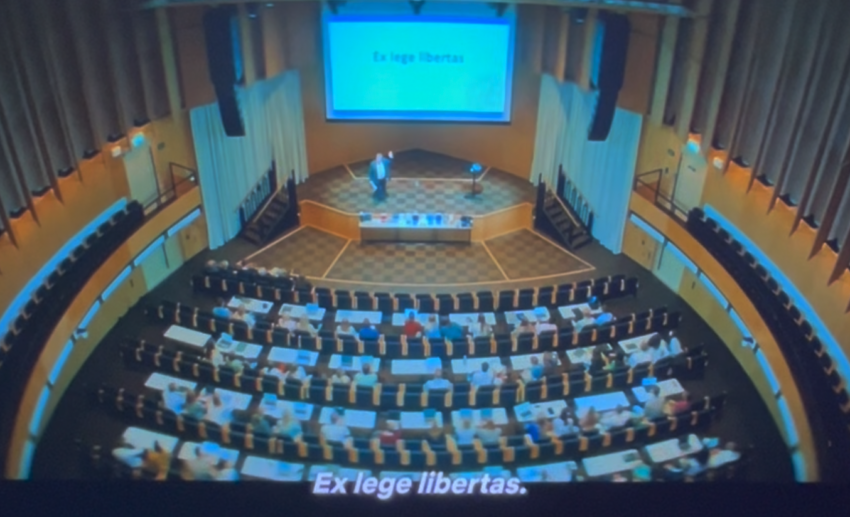
Het adagium ‘ex lege libertas’ werd in de Zweedse Netflixfilm ‘Ett ärligt liv’ goed uitgelegd: video
English Article forthcoming:”Ex Lege Libertas: The Exonerating Effect of Carbon-Budget Governance under the EU Emissions Trading System (ETS), in Carbon and Climate Law Review (CCLR, 2026-4)“
I will go discuss the expected Supreme Court decision, after the public hearing on May 2027 (decision due 2027-I). I will also go into the relation between ETS and investing in oil & gas, fossil fuel subsidies and the UN Conference on Transitioning away from Fossil Fuels (TAFF).
Energy and Climate Economics and Business days, Groningen
I presented the upcoming article on March 24, 2026 at the Energy and Climate Economics and Business days of the University of Groningen (see slides).

Summary of the article:
The European Union Emissions Trading System (EU ETS) is the EU’s central mechanism to reduce greenhouse gas emissions. This article examines whether participation in the ETS exonerates participating companies from additional civil claims to cut CO₂ emissions, such as those based on tort law (Article 6:162 of the Dutch Civil Code) or the general duty of care. It argues that the ETS provides “Ex Lege Libertas” – liberty by law – granting companies exoneration from overlapping civil reduction mandates within its scope.
In Milieudefensie v. Shell (The Hague Court of Appeal, 2024), the Court held that the ETS is a binding, ambitious and exhaustive system. For emissions already covered by the ETS, imposing additional civil reduction orders would contradict the EU’s legal and economic design. The ETS achieves emission reductions collectively through a declining EU-wide cap, not by imposing individual company quotas. Therefore, Shell—and all ETS participants—cannot be subjected to separate civil reduction duties for regulated emissions.
This exonerating effect applies both collectively (for ETS sectors as a whole) and individually (for each participant). Similar reasoning is seen in German case law (Lliuya v. RWE, 2025), where ETS rules are treated as binding limits. However, outside the ETS—such as global scope 3 emissions or activities in non-ETS jurisdictions—civil liability (e.g., for climate damages) may still arise.
Conclusion:
The EU ETS grants ex lege exoneration from further civil emission-reduction obligations within its regulatory scope. This Ex Lege Libertas ensures legal certainty, prevents double regulation, and enables collective achievement of EU climate goals. Civil liability may still apply for unregulated or extra-EU emissions, but within the ETS the law itself provides the exoneration.