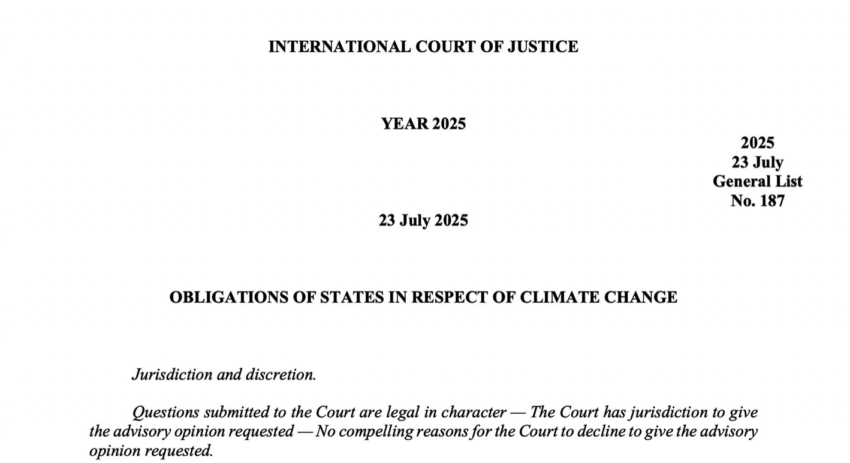
What is the impact in practice of the historic ruling through the ADVISORY OPINION of the International Court of Justice (ICJ) of Juny 25, 2025? The ICJ advice said:
- Inaction, especially by major emitting countries, is a breach of international law. That is pretty strong.
- The Court says even if the Paris Agreement has no own compliance mechanism (Article 15 is facilitating), that ‘lex specialis’ does not exclude the application of the general rules on State responsibility.
- Though the Ruling is not addressing companies a “State may be responsible where, for example, it has failed to exercise due diligence by not taking the necessary regulatory and legislative measures to limit the quantity of emissions caused by private actors under its jurisdiction, including through fossil fuel production, fossil fuel consumption, the granting of fossil fuel exploration licenses or the provision of fossil fuel subsidies”
- This shows the importance of the EU ETS setting a Paris Agreement aligned CO2 cap on companies.
- And the EU ETS also limits the embedded emissions, hence the use, of new gas and oil production,, which makes a separate ban on digging for fossil fuels superfluous.
- The priority in policy for carbon removals and cutting methane and F-gases mitigates emissions AND has a cooling impact.
Although the Advice is a ‘non binding ruling’, it is expected that countries can be seen accountable for climate damage by courts if they do not meet their Paris Agreement targets. The ruling leaves several questions though:
- Who is responsible? The EU may not be liable if they meet its net zero by 2050 target. The Court also talks about groups of countries: do they mean a common liability?
- What damage can be brought forward? Also damage that occurs already at 1,5 Degrees increase, as that is the ‘accepted’ temperature increase? Are countries also responsible for historic emissions, that for 57% came from developed countries?
- The Court says a country is only liable “if there is a direct certain causal nexus between the wrongful act of inaction and the injury itself”. The Court says “it must be established in concreto in respect of specific claims brought by States” and though “harm arising from climate change is more tenuous than in the case of local sources of pollution, this does not mean that the identification of a causal link is impossible in the climate change context; it merely means that the causal link must be established in each case through an in concreto assessment”..Well that is not so straightforward in my view.
- liable for compensation or ‘restitution may by the way take the form of reconstructing damaged or destroyed infrastructure, but restoring ecosystems and biodiversity” too.
- Interesting is that though the Paris Agreement’s Loss & Damage Mechanism (Article 8) does not ‘address issues of liability or compensation of parties for such loss and damage’, this lex specialis does not prevent a general liability and compensation either.
In my view the ICJ ruling will result in a lot of international attention and activity around the Loss & Damage Fund: more countries will need to donate and more countries will be allowed to ask for compensation and restoration via that fund.
So what is your take? Do you share my views? What is your opinion on this ruling. Will it make climate action easier?