The July 17 proposed adjustments and expansions in the European Emissions Trading System Review, (ETS), do more than strike a balance between climate ambition and competitiveness. The European Commission is also seeking a better balance between rewarding innovation and giving more time to sectors where emission reduction is most difficult. At the same time, it has added new instruments to keep the ETS effective in the long term and has further expanded CO₂ pricing. And it gives a start to financing negative emissions and international climate action. I will discuss it here. MEP Peter Liese drafted a report for discussion in the European Parliament; this will be discussed at the end.
This is necessary. Climate policy gains more support if it allows sufficient flexibility to achieve the goals, keeps costs for European industry manageable, and does not only reward frontrunners. The review also makes a start on negative emissions. These are necessary to offset the last remaining emissions and to ultimately actually remove CO₂ from the atmosphere once net zero has been achieved.
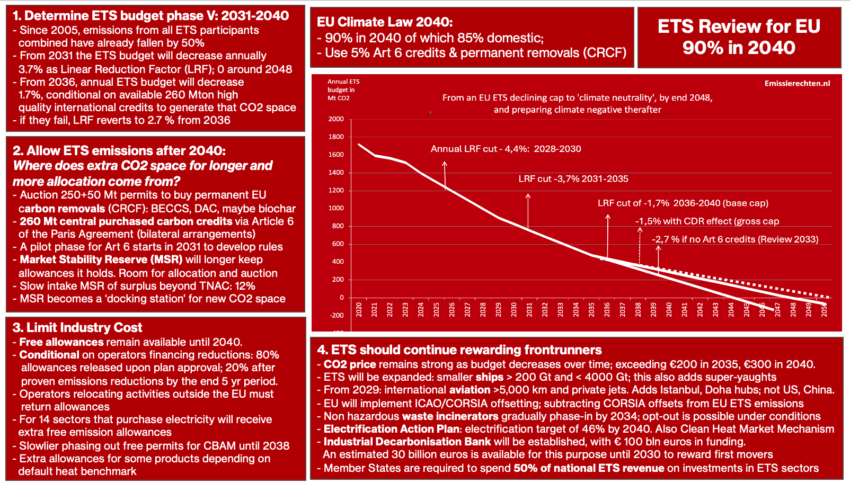
The European Commission faced four challenges during this review, besides that the ETS had to contribute to the overall EU climate target of a net 90 percent emission reduction by 2040, of which 85% within the EU.
- It had to determine the CO₂ budget for the fifth ETS period, from 2030 to 2040.
- She also had to, as defined for the EU Climate Law, make room for a limited number of remaining emissions after 2040, because some sectors will not yet be able to reach full zero by then.
- Furthermore, she had to take into account the costs for energy-intensive industries, certainly given the geopolitical situation, tarriff wars and high energy costs.
- And finally, the ETS system has to continue rewarding frontrunners.
More head room
All things considered, the Commission has succeeded reasonably well in this. The European Climate Law for 2040, agreed last year, had already provided direction for this. The package is balanced and meets all four objectives. It does not creates a weakening of climate policy. After all, there were no agreements yet regarding the next phase of the ETS after 2030. Therefore, there was no existing phase-out path towards 2040. However, it is clear that the world has changed significantly since the previous ETS revision. The industry is facing high energy costs, geopolitical uncertainty, tariff wars, a shortage of renewable energy and hydrogen, and CO₂ storage that is only really getting underway this year.
Despite these circumstances, European climate policy remains ambitious. It applies the necessary flexibility and is expanding. New sectors are being added and the system is contributing to the further tightening of European climate policy.
Ad 1) Determining the ETS Budget for 2030-2040
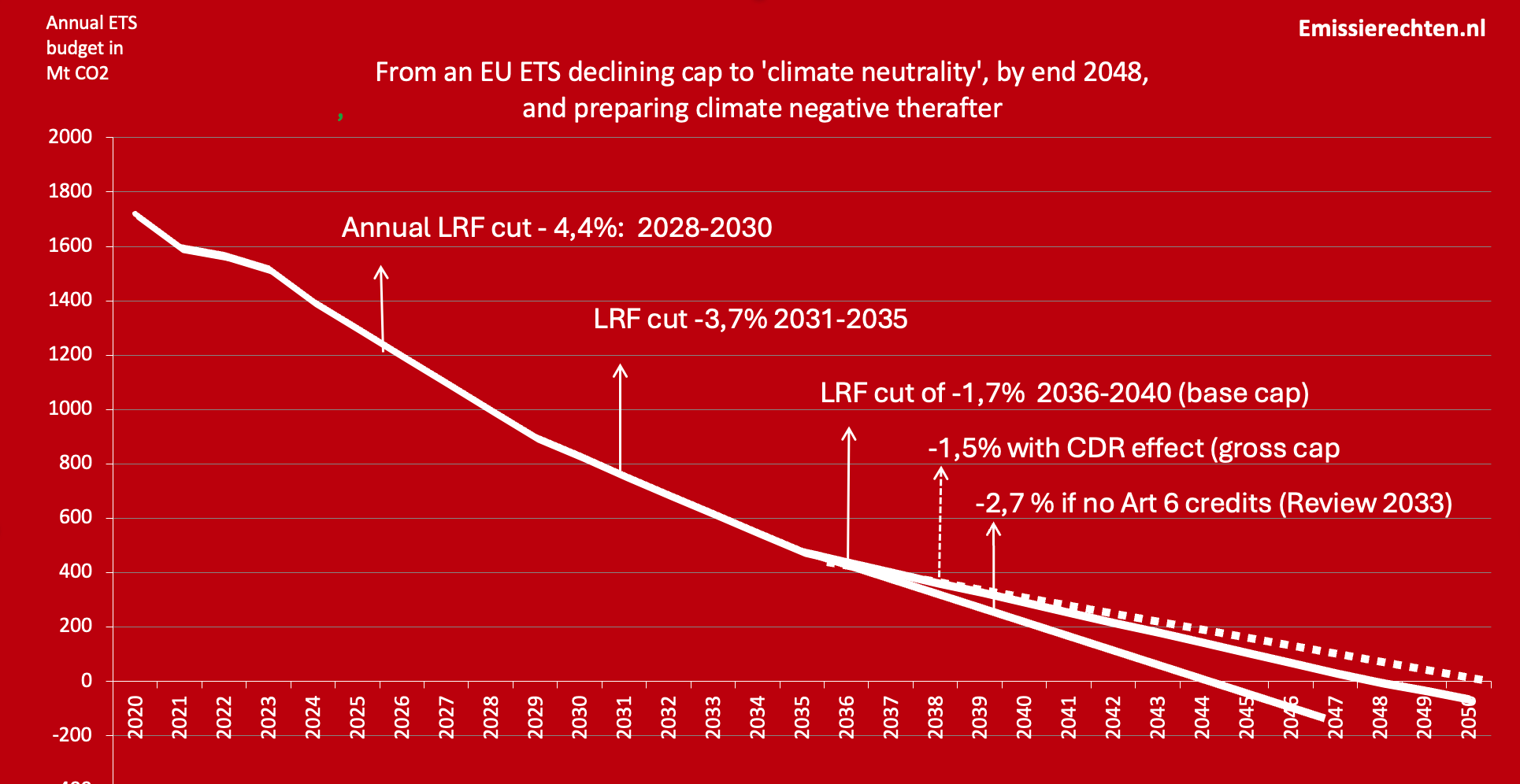
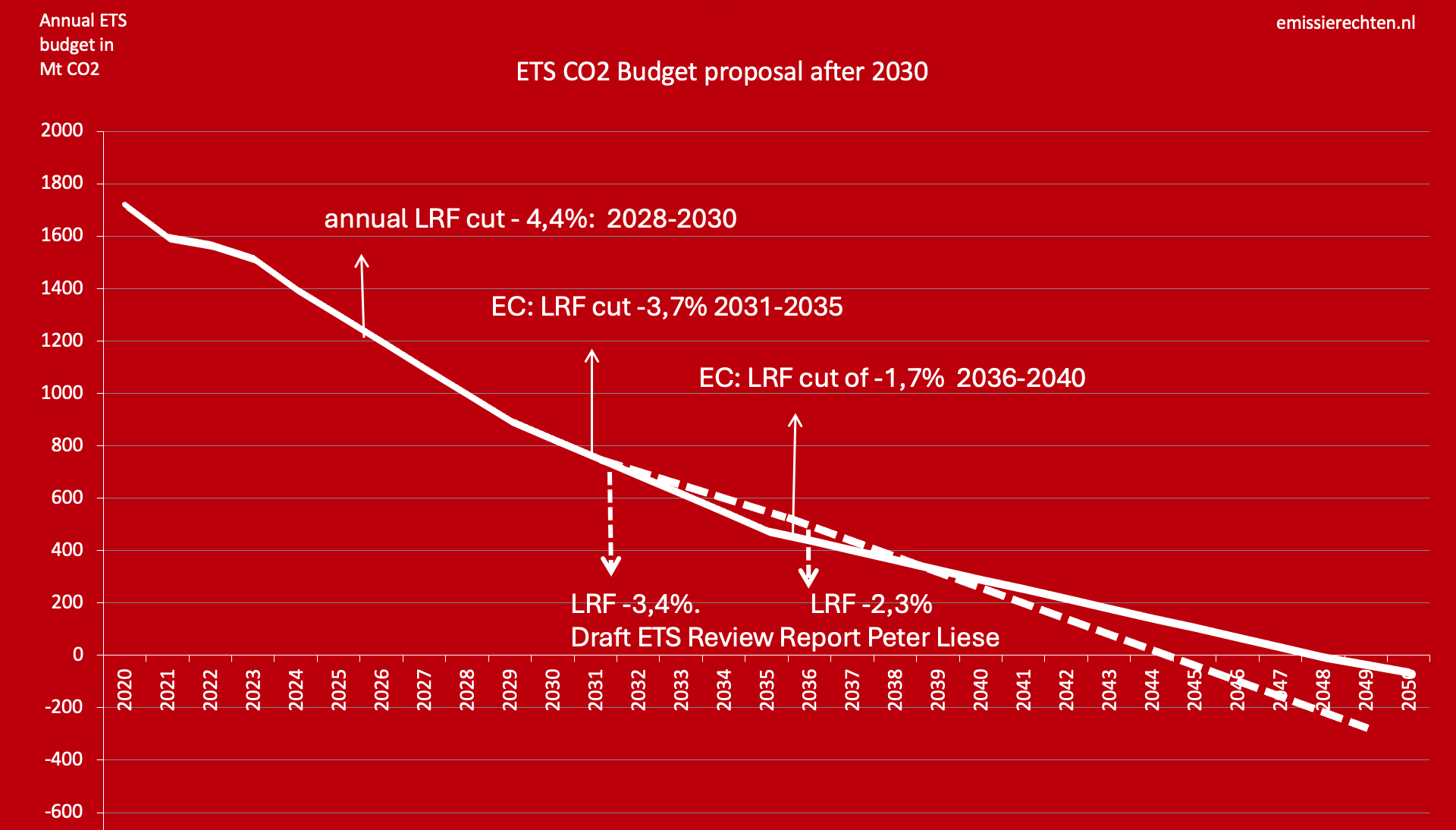
From 2031, the ETS budget will decrease annually by 3.7 percent the so-called Linear Reduction Factor LRF). This year, that budget amounted to just over 1 billion emission allowances. Since the start of the ETS in 2005, emissions from all participants combined have already fallen by approximately 50 percent. The upcoming phase therefore requires substantial reductions once again. These go beyond the regular 1 to 2 percent energy efficiency improvement per year. Companies will really have to continue investing. That 3.7 percent is a compromise. It lies between the current phase-out rate of 4.4 percent and the previously circulating proposal of 3.4 percent. With this, the Commission is opting for a steeply declining ceiling, but with slightly more room than at the current pace. 3.7 percent is roughly 75 million tonne, whereas 4.4 percent removes roughly 89 million tonne.
From 2036, the annual ETS budget will decrease by 1.7 percent. This is related to the expectation that a number of industrial sectors, as well as parts of the air and maritime shipping sectors, will not yet be able to operate entirely without physical emissions in 2040. This concerns so-called residual emissions in hard-to-abate sectors.
This ‘base cap’ of -1.7 percent is conditional on available high-quality international credits. If the review in 2033 shows they fail, it reverts to 2.7 percent from 2036, bringing an end to new allowances around the mid-2040s. The proposed 1.7 percent from 2036 removes roughly 35 million tonne. The ETS budget will then run out around 2047.
There is also a safety valve to maximise the demand for free allocated allowances:”In the event that demand for free allowances triggers the need to apply a uniform cross-sectoral correction factor (CSCF) before 2040, the share of allowances to be auctioned over the ten year period beginning on 1 January 2031 should be reduced by up to 4 % of the total quantity of allowances.”
Credibility
Ad 2) Allow ETS emissions after 2039
At the end of last year, the EU had already agreed in the European Climate Law that a limited number of emissions must remain possible under the ETS even after 2040. This requires additional CO₂ headroom, without abandoning the climate goal. This headroom is being sought through, among other things, permanent carbon removal and international carbon credits and by keeping available more allowances that are stored in the MSR.
Carbon Removals.
From 2031, the Commission intends to centrally finance approximately 250 million tonnes of European permanent carbon removals by auctioning that amount of allowances. A further 50 Mln allowance is auctioned to bridge the price gap between allowances and removals.
- Examples include BECCS or BioCCS – from bioenergy, wast to energy and municipal incinerators – and direct CO₂ capture from the air (DAC).
- Possibly also biochar, as the EU will follow the EU Carbon Removal Certification Framework (CRCF), that includes biochar as certified permanent storage.
- For the upcoming review the Commission will also consider to include nature-based carbon removals and carbon farming, if permanent storage can be ensured and by applying a buffer (para 37).
- These removals can replace the surrender of ordinary emission allowances. The text says: “cancellation of a removal unit replaces the surrendering of an emission allowance”.
- On permanence the text is pretty strong:”it is preferable to integrate only those removals for which reversals are subject to monitoring and the surrendering of allowances in the EU ETS”. That is not yet foreseen in terms CRCF (see also my blog on linking CDR to the ETS).
- The foreseen central procurement, paid on delivery 1:1 enables additional public-private financing. This is necessary because the costs of carbon sequestration are often twice as high as the ETS price. A 2034 review will evaluate price and financing.
- ETS operators, shipping companies and aircraft operators can compensate their own fossil emissions with CRCF-certified BioCCS removals that they themselves generate. This compensation mechanism cannot generate negative emissions itself. So this negative ‘premium’ can look for additional finance and help the EU towards future negative emissions.
- If we assume an ETS price of €100, for the 250 + 10 Mton allowances auction 125 Mton CDR could be purchased at € 200 ton carbon stored. A slowly increasing volume of purchased CDRs may lead to a ‘gross cap’ of -1,5% after 2036 if we include this CDR effect.
- If done at scale, carbon removals help also cooling the earth.
Carbon Credits
From 2036, the EU intends to centrally purchase approximately 260 million tonnes of carbon credits via Article 6 of the Paris Agreement. By doing so, it aims to prevent double counting. This involves structural cooperation on transition with leading developing countries. This represents approximately 2 percent of European emissions. The EU Climate Act stipulates that 85 percent of the reduction must take place within the EU itself, and a maximum of 5 percent may be achieved via carbon credits. The proposed use of credits under the ETS is therefore cautious. The remaining 3 percent remains available for non-ETS sectors. End of 2026 the national climate targets will be published.
- A pilot phase for the financing of Article 6 carbon credits will start as early as 2031. Countries like Sweden with their ongoing Art 6 MoUs can share their experiences. The EU can the develop their requirements and see what the potential is.
- Through indirect linking to the ETS, the EU maintains control over costs, quality, and volume of international credits. This is important because international credits are only credible if they are robust and easily verifiable.
- There will be an impact assessment and Union law setting robust and high integrity criteria and other safeguards; ‘where appropriate’ the rules developed under Article 6.4 of the Paris Agreement may be complemented.
- So this can also ignored and the EU could also focus on bilateral Article 6.2. arrangements. Via Art 6.2. the EU can finance carbon credits by investing in large scale transition programs in developing countries that that are likely also meet their own climate plan. Also the PIK Institute prefers to use Art 6.2. by setting up jurisdictional reward funds.
- European companies, investing in reductions and removals in their international supply chain could suggest to make these insetting activities part of Art 6.2. cooperation and transfer of credits. These foreign investments lead to a reduction of Europe’s international carbon footprint.
Central procurement of permanent carbon removals enables additional public-private financing. This is necessary because the costs of carbon sequestration are often twice as high as the ETS price.
And for purchasing international carbon credits, through indirect linking, the EU maintains control over costs, quality, and volume
MSR
The Market Stability Reserve (MSR) will also continue to play a role. Emission allowances held within it that remain available after auctions will remain usable for longer.
- This is interesting because actual emissions in recent years have consistently been lower than the ETS budget available under the Paris Agreement. This headroom can therefore remain available, including for free allocation.
- At the same time, it is quite possible that this headroom will ultimately not be fully needed. From 2028 the intake rate is halved from 24% to 12%, meaning that in the event of a surplus, future intakes will be spread over a longer period.
- Towards 2040, the thresholds and the amount of allowances released to the market become smaller obviously.
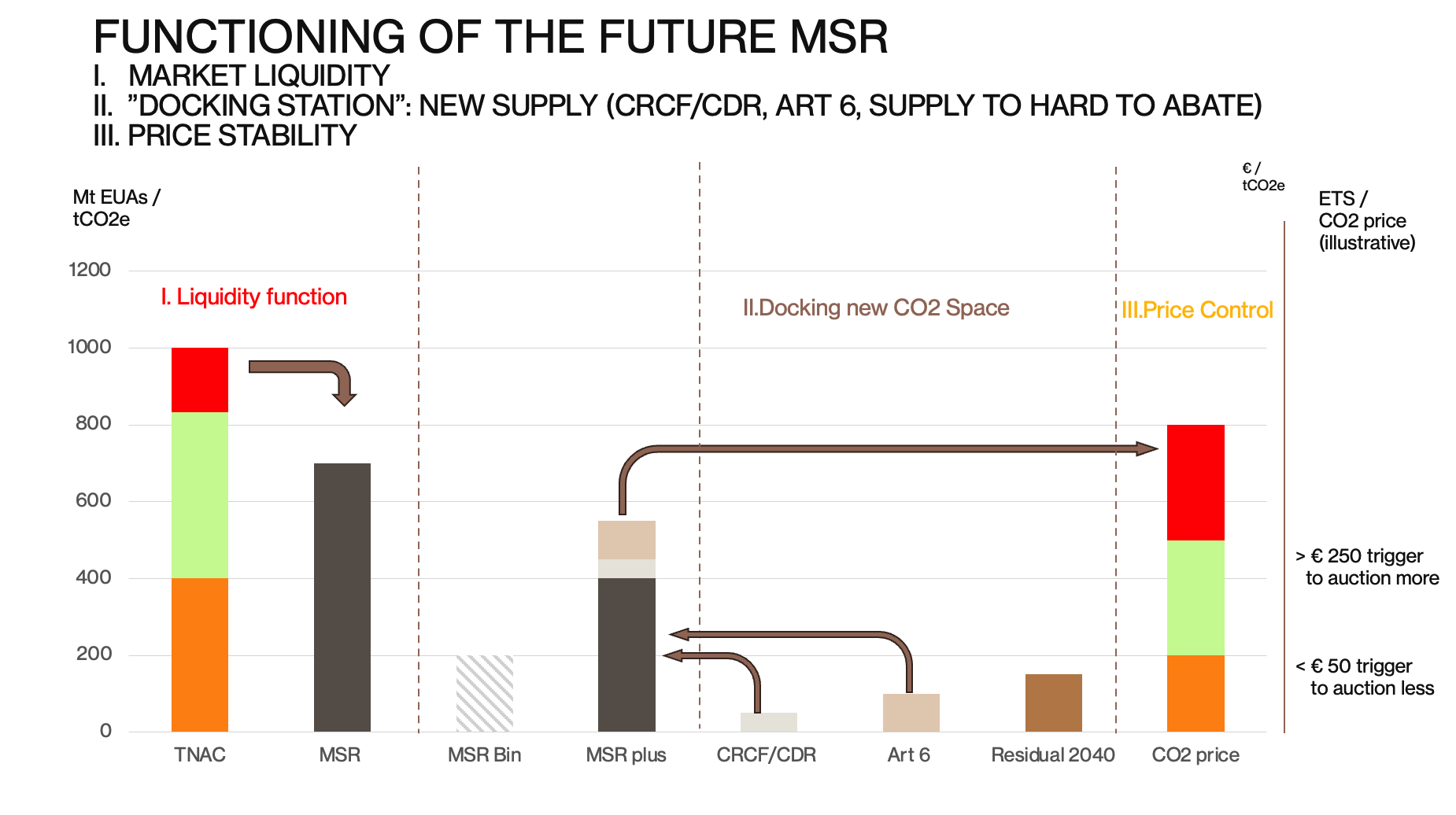
The MSR has over time been in fact developed as a sort of ‘docking station’, in which new generated CO2 space – such as Article 6 ITMOs, CRCF removals – can be plugged in and be auctioned or allocated as allowances to ETS participants. See below. A potential price control function (III) is discussed in the ETS Review, but not proposed for now.
Ad 3) Limiting cost for industry
To limit costs for the industry, free allowances are being kept available for longer, and the share of free allowances relative to allowances to be auctioned is increasing.
- Companies that receive free allowances based on an energy efficiency benchmark will retain that right until 2040.
- But from 2031, all free allocation is made fully conditional upon operators submitting a decarbonisation investment plan
- with 80% of allowances released upon plan approval and
- remaining 20% contingent on demonstrated emissions reductions by the end of each five-year period.
- Joint investments on one site are allowed within the EU for the value of allowances received for free for combined sites
- Operators relocating activities outside the EU will be required to return the 20% allowances received under the relevant provision, directly incentivising investment retention within the EU.
- These conditions are not valid for sites that operate at the benchmark
- Peter Liese MEP told media this condition could be changed: phased-in slowly, only on own site, under condition that cuts are possible (if depending in external CCS, hydro, power etc)
- Additionally, 14 sectors that purchase electricity will receive extra free emission allowances to promote electrification (€ 4 bln industrial relief 2026-2030).
- Furthermore, the phasing out of free allowances for CBAM sectors will be delayed until 2038.
- For sectors without their own benchmark, which fall under the default heat benchmark, additional allocation will become available, worth €6 billion between 2026 and 2030. This corrects an imbalance of the heat benchmark, taking into account the extensive use of biomass in Scandinavia, whereas that possibility is much more limited in the rest of Europe. This concerns, among others, the chemical industry, certain metals and metallurgy, ceramics, glass, and agri-food processing. The extra capacity comes from the 3 percent emission allowance reserve. Specific sector-based default benchmarks will be proposed later.
- State-aid via compensation of indirect carbon cost of power remains available
- The Commission promises to reduce administrative compliance costs and enhance system implementation Introducing via simplification for industry and public authorities.
Green companies and financial support
Ad 4) ETS remains rewarding frontrunners
The CO₂ price is expected to remain strong in the long term because the budget continues to decrease. While the phase-out path will be slightly less steep, meaning the price will rise less sharply than with a stricter ceiling, the structural direction remains clear.
- The market reacted visibly to the review. The ETS price briefly fell below 80 euros on July 17, but subsequently rose again above 86 euros per ton. In the run-up to the review, the market feared that the Commission would consider bringing an additional 400 million emission allowances onto the market without conditions. That did not happen. The proposed LRF turned out to be stricter than expected.
- Various polls and models suggest a potential ETS price of around 150 euros per ton in 2035 and 200 euros in 2040.
- In September TBI said their model show a 2% use of high quality ITMOa gives a 6% lower ETS price
- Even for sectors receiving extra free allowances, there remains an incentive to reduce emissions. Those who innovate faster can avoid costs or recoup value through the sale of rights. Laggards, on the other hand, are pushed forward, because they are required to invest the saved money in their own site in exchange for free rights.
The ETS is being expanded.
- Smaller seagoing vessels, offshore and general cargo ships of 400 to 5,000 gross tonnes will fall under the system: this adds 16%. That means large super-yachts that can weigh 400 to over 1,000 Gt will also be included (around 14 Mton CO2).
- As of 2029, International aviation from the EU up to 5,000 kilometers calculated from the Airport of Frankfurt is included. Flights to hubs like Istanbul and Doha will be included, but not flights to China and the US. Some 43% of European flights will be included then.
- Also included private jets emissions will be in the EU ETS, regardless of destination.
- The EU decided that it will implement ICAO’s offsetting programme CORSIA, and that purchased offsets will be subtracted from EU ETS emissions to avoid double counting. For the CORSIA offsetting the EU will not apply additional credit criteria for now. Operators that implement contrail avoidance measures can receive extra allowances, after introducing the MRV for non CO2 impact of flying.
- Additionally, 110 mln allowances are allocated to support EU-produced sustainable aviation fuel (SAF)
- Waste incineration plants (non hazardous) are being gradually brought under the ETS by 2034 for the fossil portion of their emissions (incinerating > 3 tonnes/hr). This is around 38 Mton CO2e). Since 2024, emissions from municipal waste incineration installations have already been subject to monitoring, reporting and verification obligations. Opt-out for waste incineration and co-incineration is allowed under conditions. ETS could make CCS in waste incineration more attractive, as capturing the biogenic portion—approximately half of the emissions—can lead to negative emissions.
- As carbon can be captured that have emissions resulting from a mix of fossil and zero-rated sources, detailed rules are needed regarding the order of which the different types of CO2 are considered to be captured and how to account for their emissions across the carbon capture, transport, utilisation or storage chain. And it should be subject to a surrender obligation when the CO2 is leaked, vented or otherwise released.
- Accounting of non-permanent carbon capture and utilisation (CCU) will be added: the EC will draft a list of products from which carbon is expected to be re-emitted from non-permanent CCU to become subject to carbon pricing. So ‘incinerated plastic waste emissions’ are counted towards the plastic producer, incentivising recycling. The Commission sees this as part of the forthcoming Circular Economy Act. For synthetic fuels, will be added to the ETS Directive as activity, covering the distribution points for synthetic fuels.
Simultaneously with the ETS review, an Electrification Action Plan (EAP) has been proposed, with an indicative electrification target of 46 percent by 2040. Currently, that share stands at around a quarter. According to the Commission, this could reduce European gas imports by more than 70 percent. Furthermore, the aim is to reach 200 gigawatts of storage capacity by 2030 and accelerate the rollout of renewable electricity. The EAP includes a strategy to increase heat pump installations to 4 million per year by 2030, from 2.4 million in 2025
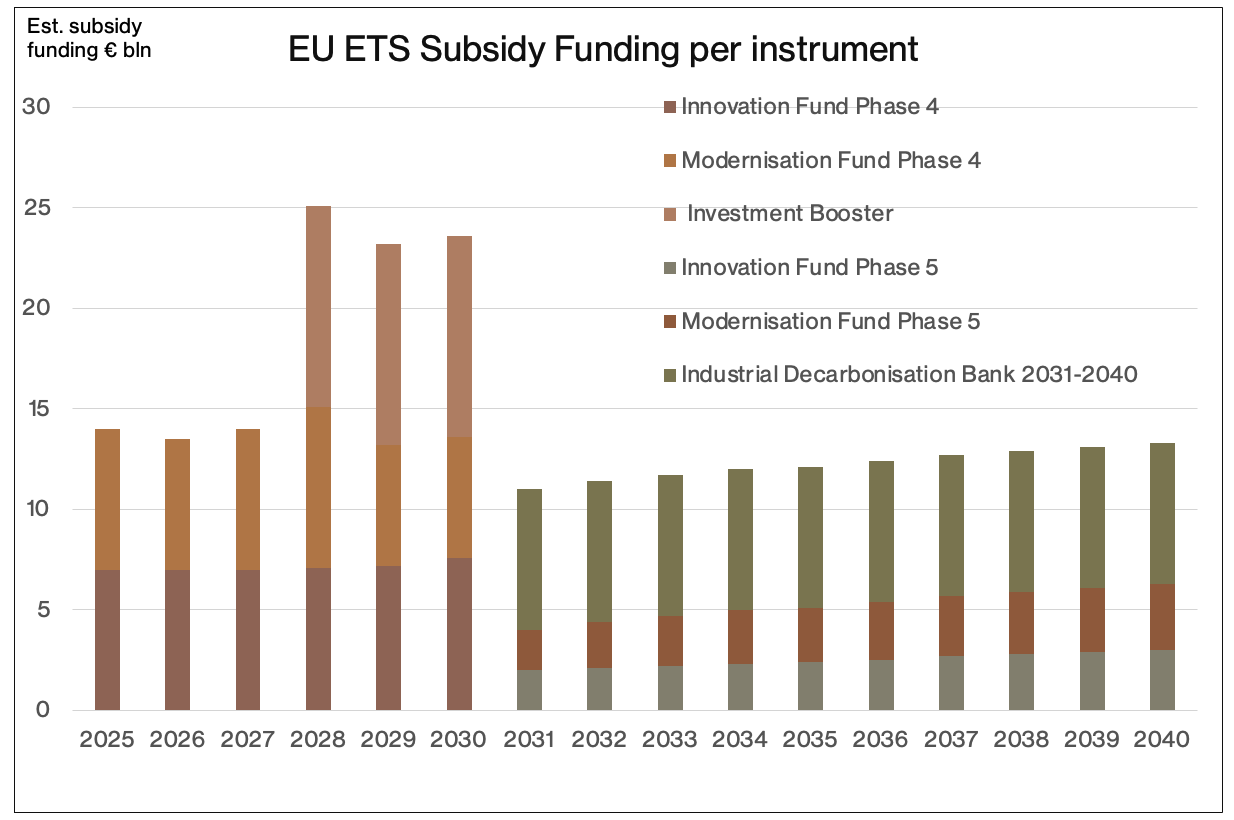
An Industrial Decarbonisation Bank will also be established, with 100 billion euros in funding.
- In the first phase, 2028-2030, the bank is intended to accelerate investments through an Investment Booster. 400 million allowances will be auction for industrial decarbonisation projects. At a carbon price of around €75/t, this represents €30 billion. This will be available to mitigate investment risks and reward first movers with CCfDs. Think of fast electrification of big heat pumps.
- From 2031 to 2040, the IDB would enter its second phase. It would be backed by a further 400 million earmarked allowances – this time directly from the Union-wide ETS cap.
Additionally, Member States will be required to spend 50% of their national ETS revenues on investments in making ETS sectors more sustainable. This could generate more than 100 billion euros in investments before 2030.
Trump Card: Price Corridor
The Commission may be keeping another trump card up its sleeve. The Market Stability Reserve will remain filled for longer with emission allowances that fall within the initial CO₂ ceiling and with unused reserve allowances. And it will take a lesser percentage from the market in case too much are circulating. These stored allowances will not simply be released, but could be auctioned off if the CO₂ price rises too high. This could become particularly relevant during periods of scarcity. See price the potential function of the MSR (III) in the picture above.This also brings back the discussion regarding a price corridor (Like in California, UK and Washington State). A ceiling price can prevent extreme spikes, while a floor price provides certainty regarding the minimum incentive to invest. In the past, about half of the Member States proved open to this, depending on the trigger for issuance of course. For ETS-2, the system for buildings and transport starting in 2028, the Market Stability Reserve already acts as such a CO₂ price stabiliser.
For now the EC discarded this option for now:“While these measures have theoretical merit, they face significant institutional barriers, require multi-year preparation timelines, and represent departures from the MSR’s established operational principles, hence are not feasible for implementation by 2028.” With the Article 29a release mechanism, the MSR itself has a rule- and price-based element to respond to significant price movements (Impact Assessment Part 3, page 110-111)
Summary
All in all, the package remains ambitious and in line with Paris. At the same time, it acknowledges that geopolitical and economic circumstances have changed. It is justifiable to utilize the maximum CO₂ margin and create new margin through carbon sequestration and carefully selected international credits. Energy-intensive industries are heavily impacted by high energy costs and international competition. The ETS is intended to make achieving CO₂ targets affordable. This can help green companies, but that is not the goal in itself. It gives a start to financing negative emissions and international climate action.
Ultimately, this review is about the final result. To garner broad support, the package contains both more ambition and more margin for emissions after 2039. Particularly attractive is the combination of a less steep linear reduction factor, adjustments to benchmarks, new emission allowances in exchange for permanent carbon storage for hard-to-abate sectors, and limited margin for international carbon credits after 2036.
Of course, much depends on the implementation. Member States must invest, permits must be granted, sustainable technology must become available, and carbon sequestration and carbon credits must be reliable, affordable, and verifiable. If these preconditions are not met, the ETS will remain strict but will become less effective as an investment instrument.
Moreover, by including international credits to a limited extent, the EU ensures that developing countries with which Europe has trade relations, and from which products are also imported, will do more regarding climate policy and CO₂ pricing. This can contribute to a broader international movement, provided the quality of those credits is properly safeguarded.
The ETS review therefore does not just try to please everyone. It attempts to prepare the system for a next, more difficult phase. The ETS remains ambitious but is becoming more realistic regarding the time required by some sectors. It gives industry more leeway but maintains pressure for reduction. It introduces new instruments but tries to retain control over quality and volume. That is exactly what is needed. The ETS must not only be strict but also workable. Only then will it remain an effective instrument for achieving European climate goals without unnecessarily weakening Europe’s industrial base.
MEP ETS ETS Review Rapporteur Peter Liese looking for more balance
Peter Liese presented his draft report in an EPP press briefing to prepare a broad agreement in the European Parliament (https://lnkd.in/em_r_t-b ).
Key changes include:
– #LRF from 2031: -3,4% (EC: -3,7%), see dotted line
– LRF from 2036: -2,3% (EC: 1,7%)
Justification:”Whilst significant efforts must be made in the first half of the decade, the balance between the two periods could be improved”
– Start using EU carbon #removals in 2029 (EC: 2031) and make also use of biochar for 20%, with priority to DACCS and BioCCS (removals are relevant to compensate hard to abate emissions after 2045)
– No cap on the total purchase of removals, and in stead of 10 Mton extra besides the 250 Mton, sufficient enough allowances will be auctioned extra to finance this
– Use of Art 6 #credits (financed with 260 Mt allowances auction), with priority to using EU technologies (for example removals), and delete the ‘revert to’ clause to a threatening higher LRF from 2036.
– slowly phase-in of the investment #conditionality for free allowances: with one third of the allowances and phase in this condition over time.
Justification:”For some companies, the investment depends on conditions that they don´t fully control, for example CCS infrastructure, hydrogen infrastructure and grid. One third of the allowances that will be available after the review in 2031 are new and wouldn´t be available for installations if the review fails.”
– prevent excessive #price fluctuations (29a): in case the CO2 price is +/- 25% compared to 3 preceding months, less/extra allowances will be auctioned. Strong price highs may harm competition and strong price drops may, in harm frontrunners.
The carbon market responded disappointed with a 1% drop from €85,9 to just above €85:
– they see a lower near-term ambition before a higher long-term ambition
– traders may also not be happy with the lower trigger in Art 29a giving more uncertainty for traders, but more certainty for investors.