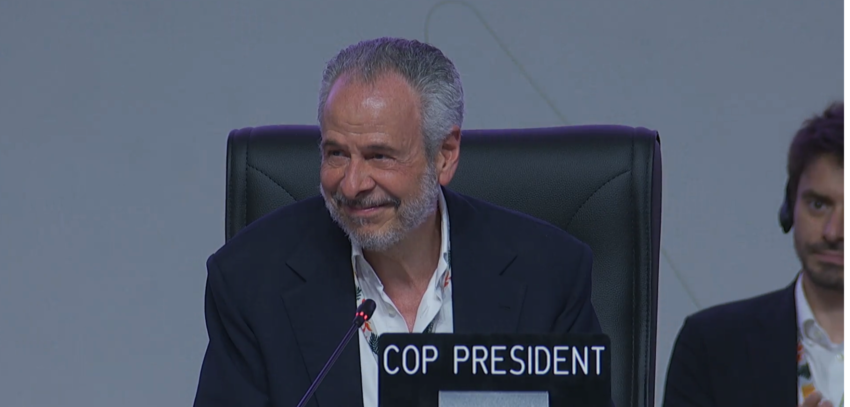
Last month’s annual climate summit in Belem, Brazil – CoP30 – is the meeting of the highest body of the Climate Convention and the Paris Agreement. On the one hand, annual operational and substantive decisions are made here, regarding reporting, the budget, progress on achieving climate goals, and guidelines for the carbon credit system. These are topics that are being prepared. And delegations come to the summit with a mandate.
On the other hand, it has increasingly become a political meeting. Demonstrations and blockades are taking place on-site to enforce demands on the ground. And each rotating host country chair can seek support for several key issues and present a supplementary ‘Cover Note’, beyond nations’ mandate. This aspect gets all the media attention but cannot but fail. This creates excessive expectations, which entails risks that further erode support for climate policy.
What went well?
- The Brazilian presidency has secured increased funding for adaptation for developing countries: countries contribute voluntarily.
- A $125 billion fund for Amazon and tropical forest protection will be established (The Tropical Forest Forever Facility) with a handful of donors: $6.5 billion is pledged ($3B Norway, $1B Brazil/Indonesia, €500M France, Netherlands will support $ 1 5 mln for the start-up).
- And there’s a political roadmap to $1.3 trillion/year in climate financing by 2035.
- It’s also good that there was no disagreement about the use of the carbon market. The previous Climate Summit gave the green light for this. The UN Commission, which will issue the so-called Art 6.4 carbon credits, can continue to propose carbon methods for specific types of projects. The Climate Summit welcomed dozens of bilateral Art 6.2 carbon deals, such as those by Switzerland and Sweden. However, they did call for more transparency regarding the agreements and insight into whether they contribute to ambition.
- The summit also saw the establishment of the “Article 6 Ambition Alliance (AAA6),” led by Switzerland, to demonstrate how the carbon market leads to more ambitious climate goals. The Netherlands is an observer, as it doesn’t yet have any Art 6 activities. Last month, the EU was able to agree on the ambitious 2040 CO2 target of 90% by using 5% of the Article 6 credits. So that circle is complete.
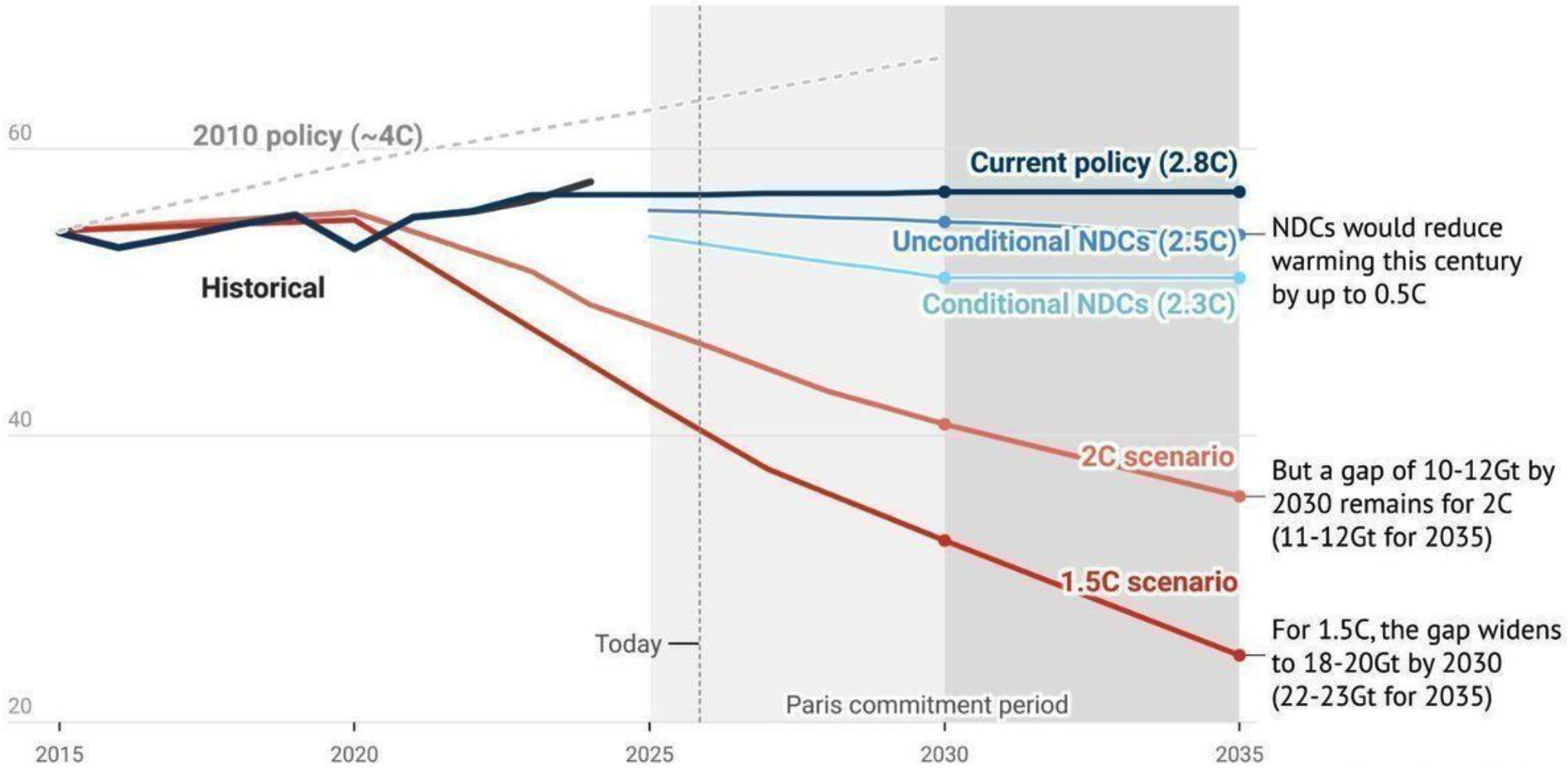
Source IPCC/Carbon Brief: This figure shows that if countries implement their climate plans, the average temperature increase will be 2.5 degrees. If they use the Paris Agreement carbon credits, the average temperature increase will be 0.2 degrees lower, reaching 2.3 degrees.
What went wrong?
The media are mainly reporting that the summit failed because no fossil fuel phase-out path was agreed upon, that fossil fuel lobbyists shouldn’t be present at the summit, and that oil-producing and coal-intensive countries, India, and China, blocked a consensus. The Brazilian chairman said that around 80 countries were unwilling to make an agreement on this.
But the Paris Agreement does not specifically require countries to ban fossil fuels (which contribute 64%). Nor does it require countries to reduce agriculture (25%) or ban air travel (5%). The Paris Agreement requires countries to reduce CO2 emissions. The IPCC ideally wanted 45% by 2030. The EU itself is aiming for 55% by 2030 and zero by 2050. The EU CO2 Emissions Trading System (ETS) is even aiming for -62% by 2030 and zero by 2040. Countries can therefore choose how to reduce CO2 in their climate plans: efficiency, recycling, CCS, CCUSE, carbon capture, and the use of international Article 6 credits. In my opinion, this sovereignty to choose and flexibility are essential for this ambition.
I do understand the political views and that some want to fight the fossil fuel companies themselves. But even The Netherlands still needs oil and gas for power generation and transport for the time being. The Paris Agreement is policy- and technology-neutral. Also the Advisory Opinion of the International Court of Justice (ICJ) of July 23, 2025, indicated that it concerns the reduction of emissions from fossil fuels, not the fuels themselves or the permits for them [1]. Therefore, countries that use fossil fuels and extract oil must indicate how they stay within the CO2 targets. And as for the presence of fossil fuel lobbyists, I didn’t notice any actual impact on the outcomes at the 20 climate summits I attended. There are also countless environmental organizations. Countries are given a mandate, coordinated with their parliaments. As an environmental minister, you can’t suddenly make more far-reaching agreements at a summit, supported by environmental organizations.
Fossil Fuel Controversy From the Beginning
Ever since the Climate Convention (1992), Kyoto Protocol (1997), and Paris Agreement (2015), oil-producing countries have been putting on the brakes. They cast doubt on the science, and when progressive steps are taken, they demand that the impact on the oil and gas market be taken into account. If climate policy leads to less oil use, this must be compensated for. In any case, the effect of the so-called “response measures” must be examined. Developing countries are protesting against the European CBAM levy for the same reason: countries that import goods into the EU with lower CO2 costs must pay a levy: they don’t want the EU to impose European standards on them.
And even though countries are now aiming for 2.5 degrees by the end of this century instead of 4 degrees before the Paris Agreement, there is still a gap. As said, the IPCC says that global emissions must be 45% lower by 2030; the current target is 11%. Scientists and NGOs point to the increasing emissions from burning coal, oil, and gas. This is where the call for a phase-out of fossil fuels comes from.
So how bad was it?
“Perhaps the best we can do in this current climate is not to take huge steps backward,” said European Commissioner Wopke Hoekstra, adding that people are reasonably satisfied that “an agreement has been reached on a global response to keep the 1.5-degree Celsius limit within reach.” And Ursula von der Leyen, President of the European Commission, said that “the fight against climate change is not aimed at the fuels that cause it, but only at the pollution they emit.”
I think the Dutch government can therefore be pleased that a coalition of 24 countries, led by Colombia and the Netherlands, attended the summit in April 2026 to discuss what a fair fossil fuel phase-out path could look like.[2] At the summit, Minister Sophie Hermans announced that the Netherlands will close the oil refinery in Aruba, supported by green subsidies, and that the Netherlands will stop generating electricity from coal by 2030. However, she was quick to point out after the summit that the Netherlands cannot yet phase out fossil fuels: “Climate Minister Hermans certainly does not want to ban fossil fuels yet.” So, it’s more of a political statement than an obligation. However, the impression has been created that this phase-out path must be fixed.
And what is next?
Thanks to the Colombian-Dutch initiative, the Brazilian chairman decided to develop a roadmap for phasing out fossil fuels himself, along with several other countries, and to take advantage of the aforementioned April 2026 conference (he will also develop a roadmap to prevent deforestation).
To avoid frustrations at the next climate summit, I believe it’s important to manage expectations beforehand through the consensus rule and by ensuring that all countries determine how they achieve their CO2 targets and shape the transition. “In this new geopolitical reality, Europe must be much more proactive in seeking allies,” said Green MEP Sara Matthieu.
I believe that annual Climate Summits will remain necessary to review the current state of affairs and keep countries on their toes, committing to the 1.5-degree target. But don’t expect consensus on how to achieve the climate goals, and don’t expect us to see constantly shifting coalitions.
In the mean time, countries should, besides bringing emissions down, tackle the overshoot of 1,5 Degrees with measures that help direct cooling, including:
- Carbon removal
- Methane reduction
- Increase the albedo effect (white)
- Apply green-blue structures to cool living erea’s
See also my earlier column: Countries should take cooling targets
————
[1] Failure of a state to take appropriate action to protect the climate system from GHG emissions—including through fossil fuel production, fossil fuel consumption, the granting of fossil fuel exploration licenses, or the provision of fossil fuel subsidies—may constitute an internationally wrongful act attributable to that state. The Court also emphasizes that the internationally wrongful act in question is not the emission of GHGs per se, but the breach of conventional and customary obligations identified under question (a) pertaining to the protection of the climate system from significant harm resulting from anthropogenic emissions of such gases.
[2] Colombia and the Netherlands will host the ‘Just Transition Away from Fossil Fuels’ conference on April 28-29, 2026, in Santa Marta, Colombia. 24 countries support the Belém Declaration: Australia, Austria, Belgium, Cambodia, Chile, Colombia, Costa Rica, Denmark, Fiji, Finland, Ireland, Jamaica, Kenya, Luxembourg, Marshall Islands, Mexico, Micronesia, Nepal, the Netherlands, Panama, Spain, Slovenia, Vanuatu, and Tuvalu.